

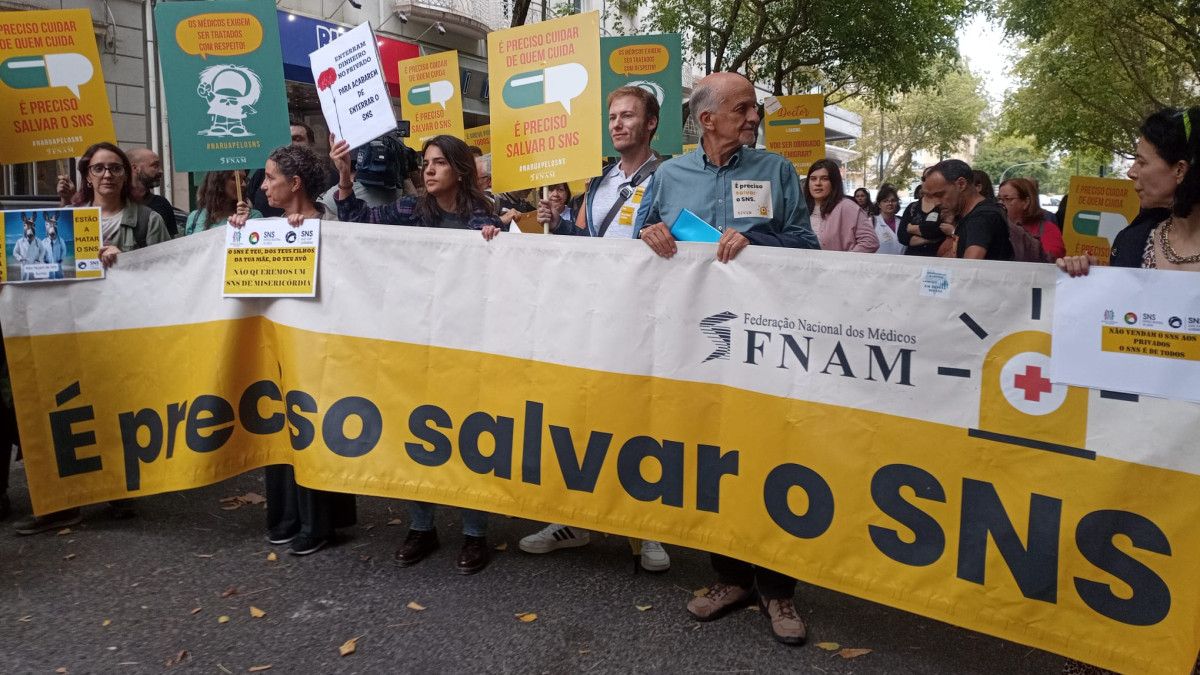
Fnam president Joana Bordalo e Sá accused the government of inaction and criticised proposed forced mobility in emergency services, warning it could harm maternal care outside large cities.
The National Federation of Doctors (FNAM) reported an estimated 80% participation in the nationwide strike on 24 October. The walkout caused widespread disruption across Portugal’s healthcare system. Many operating rooms were closed and thousands of medical consultations were suspended in both hospitals and health centres.
Fnam president Joana Bordalo e Sá said preliminary figures show particularly high adherence in the North, where hospitals such as São João, Santo António, Padre Américo, and the Portuguese Oncology Institute in Porto halted nearly all scheduled surgeries. In the regions of Alto Minho and Braga, health centres reportedly reached close to 100% participation, while in the Centre, units in Coimbra, Baixo Mondego, and Viseu also joined. In the South, Portalegre’s Hospital Doutor José Maria Grande and Lisbon’s ULS São José adhered completely.
The union leader criticised Health Minister Ana Paula Martins and Prime Minister Luís Montenegro for what she described as “inaction and lack of dialogue,” particularly regarding the government’s proposal for mandatory mobility in regional emergency departments. According to Fnam, the measure risks undermining maternal and neonatal care in areas far from major cities.
Bordalo e Sá further accused the minister of misleading Parliament by claiming the proposal would not advance, arguing that her management failures, such as leadership changes at INEM and delays in oncology services, demonstrate a lack of competence. She called for Martins’ replacement and accused the government of disrespecting negotiations, claiming that new health decrees were already approved before discussions concluded.
The strike coincides with a broader Public Administration walkout organized by the Common Front, which includes teachers, nurses, transport workers, and civil servants, protesting deteriorating working conditions and public service underinvestment.






 English
 Nederlands
 Deutsch
 Français
 Español
 Italiano
 Svenska
 Pусский
 中文
中文 Türkçe
 Português
 Polski
 عربي
عربي Suomi
Suomi עִברִית
 Português (Brasil)
What a mess. Ever notice this chaos in the private health sector? I remember the good old days of private health care in America when doctors had their own offices and even came to your house. They were paid in cash and even working class families could afford their services. Socialized medicine is a disaster but everyone wants it because they think it's "free". I used to pay my private insurance and it was dirt cheap. Then Obama decided to "improve" upon private healthcare and the costs skyrocketed. Don't you Europeans understand that any socialized enterprise is bound to fail because what socialism does is constrict forcefully the amount of providers that can enter the "marketplace", which is no longer a marketplace since one exclusive provider does not make a market? This constriction is why all socialist experiments are disasters. Has everyone forgotten the food lines in the Soviet Union?
By Tony from USA on 27 Oct 2025, 21:59