

The growth - a teratoma – is, according to research, “a tumour with tissue or organ components resembling normal derivatives of more than one germ layer”.
Online encyclopaedia Wikipedia states: “Teratomas are thought to be present at birth (congenital), but small ones often remain undiscovered until much later in life”.
The bizarre discovery was unearthed in the Largo do Carmo cemetery during an archaeological dig carried out by the
Universities of Coimbra and Lisbon, and Lisbon council.
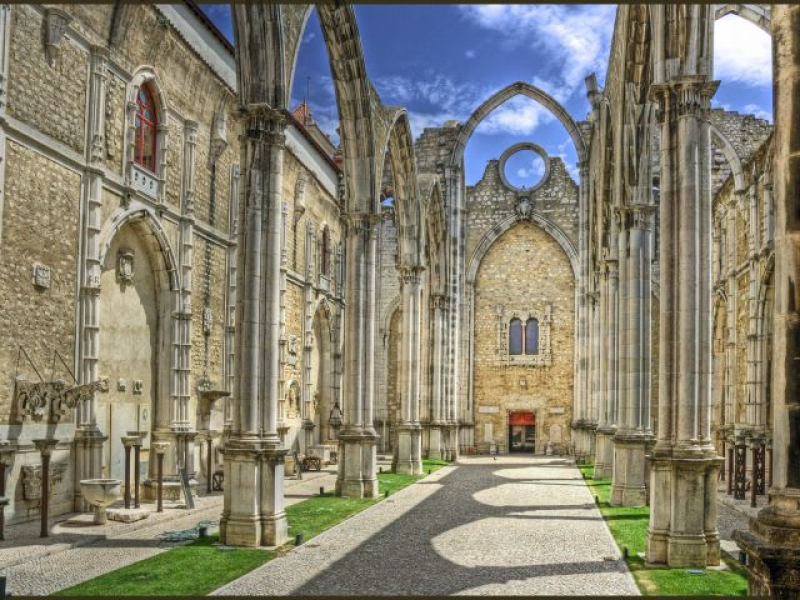
The old Gothic cemetery, near the Carmo Convent and Church, was used between “the 15th and 18th centuries” and came to an end as a result of the 1755 earthquake, researcher, Sofia Wasterlain, of the University of Coimbra told Lusa News Agency.
According to a study published in the International Journal of Paleopathology, the tumour measures between 3.8 centimetres in length and 4.3 centimetres in diameter, and contains five malformed teeth.
The calcified tumour, found in the pelvic area of a skeleton, is an “irregular and disorganised” mass, which includes five malformed teeth on its surface, according to the study.
Excavations started in 2010/2011, but only during the second phase, from 2013 to 2015, was it possible to analyse and study the case.
The female skeleton in which the tumour was found, Wasterlain explained, is thought to have been over 45-years-old, and there is “no evidence” that the tumour was
malignant.
Most teratomas are benign, and because of their size can cause “some problems and put pressure on some organs”, the researcher explained, noting that no lesions of this kind were found.
Although the reason for the death of the woman is unknown, the lime found covering the skeleton suggests she may have died of an infectious disease as it was common to throw lime on bodies when that was the cause of death.
There are only three other known cases of teratomas in paleontological literature and this type of
tumour is “relatively
uncommon”.
It can include “multiple types of tissue”, and teeth or hair can be formed inside it.
“The teeth were immediately obvious”, said the researcher from the Department of Anthropology at the University of Coimbra.
According to the anthropologist specialising in biological anthropology, “it is important to make these differential diagnoses”, to complement historical sources and “the history of diseases”.
“There is a widespread notion that cancer or tumours are a product of our Western life and we actually end up finding cases from many centuries ago. It is important to document these cases “to understand how things happened in the past and not just today”, Wasterlain added.
Rare tumour with teeth unearthed in Lisbon cemetery
A rare type of tumour containing five teeth has been dug up in an old gothic cemetery in
Lisbon, and is one of only four such cases known in the world.
in World · 08 Jun 2017, 13:18 · 0 Comments
Share this article: Share






 English
 Nederlands
 Deutsch
 Français
 Español
 Italiano
 Svenska
 Pусский
 中文
中文 Türkçe
 Português
 Polski
 عربي
عربي Suomi
Suomi עִברִית
 Português (Brasil)