

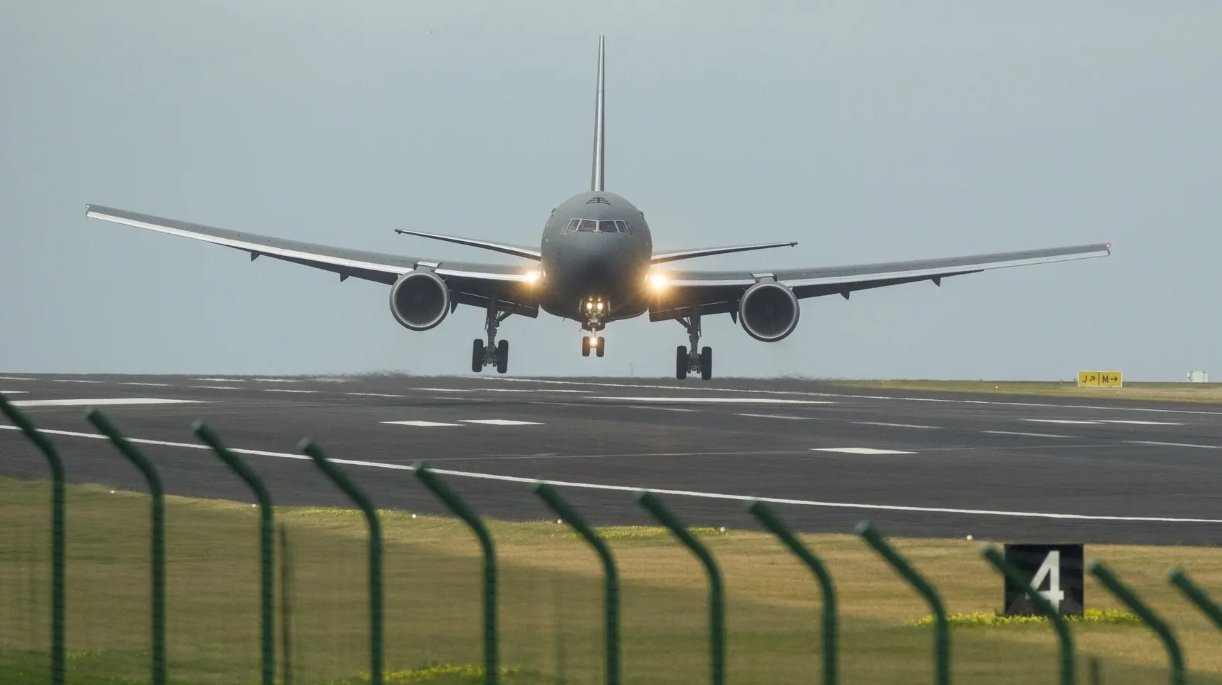
On the morning of 2 March, only four of the 15 KC-46 Pegasus refuelling planes left Lajes Air Base, which had been stationed there for over a week.
However, on Sunday, 1 March, there were 13 sorties of these aircraft, which can refuel military planes in flight.
In the morning, five refuelling planes took off, returning in the early afternoon, and in the late afternoon, eight aircraft took off in two groups, returning to base at night.
Even though there is no official information, these aircraft may be refuelling American military planes travelling between the United States and the Middle East or vice versa.
Departure times and flight times have been inconsistent.
Since 18 February, the movement of American aircraft at Lajes Air Base has intensified.
In addition to the 15 refuelling planes, 12 F-16 Viper fighter jets, a C-17 Globemaster III military cargo plane, and a C-5M Super Galaxy cargo plane, the United States Air Force's largest strategic transport aircraft have passed through the infrastructure.
On Friday, 27 February, the day before the attack on Iran, two refuelling planes took off from Lajes in the early afternoon and returned at night.
On Saturday, 28 February, five refuelling planes took off and returned at night.
Some C-130 aircraft, commonly used for transporting troops and cargo, from the United States Air Force and Navy, have also been passing through Lajes Air Base.
On Saturday, 28 February, a P-8 Poseidon, a military aircraft developed for the United States Navy and designed for anti-submarine warfare, also took off from Lajes.
A week earlier, even before the attack on Iran, the Minister of Foreign Affairs, Paulo Rangel, said that the Cooperation and Defence Agreement between Portugal and the United States provided for "tacit authorisations," "given within a relatively short timeframe," for the use of the Lajes Air Base.
On Sunday, 1 March, the president of the Regional Government of the Azores stated that the Agreement "was fulfilled" and that the region's importance "was reaffirmed" by the recent attack on Iran.
In a political statement without allowing questions from journalists, José Manuel Bolieiro said that "in the current international context of war," the Government of the Azores and the Government of the Republic "maintained contacts and exchanged information" through the Prime Minister, the Minister of Foreign Affairs, and the President of the Azorean Executive.






 English
 Nederlands
 Deutsch
 Français
 Español
 Italiano
 Svenska
 Pусский
 中文
中文 Türkçe
 Português
 Polski
 عربي
عربي Suomi
Suomi עִברִית
 Português (Brasil)
Why does Portugal allow a military airbase of any foreign country on its soil? I never even hear about any politicians raising this issue.
By Mark from Porto on 02 Mar 2026, 15:31
To answer the other comment, Portugal and other countries allow use of its bases because of various treaties, which include protection (eg, NATO) if Portugal was attacked.
By John from USA on 03 Mar 2026, 11:40
Aiding and abetting the indiscriminate slaughter of children .
By James O'Connell from Algarve on 03 Mar 2026, 14:52
We ought to be thankful to the US for not turning Lajes similar to the status of British military bases in Cyprus, which are British territory in the Cypriot island.
By Diogo F. from Madeira on 03 Mar 2026, 18:39
Maybe too far away for Iranian drones, but sad that the Portuguese government sanctions an illegal war!
By Greg from Other on 04 Mar 2026, 09:47
This shows how incompetent and impotent our Government and Politicians are. People justifying the reason to provide our Air Bases to the Aggressor just because he is our Ally shows the Slave mentality with weak understanding of how Law and Order with Human Rights actually functions
By Joy Divine from Alentejo on 10 Mar 2026, 18:43