

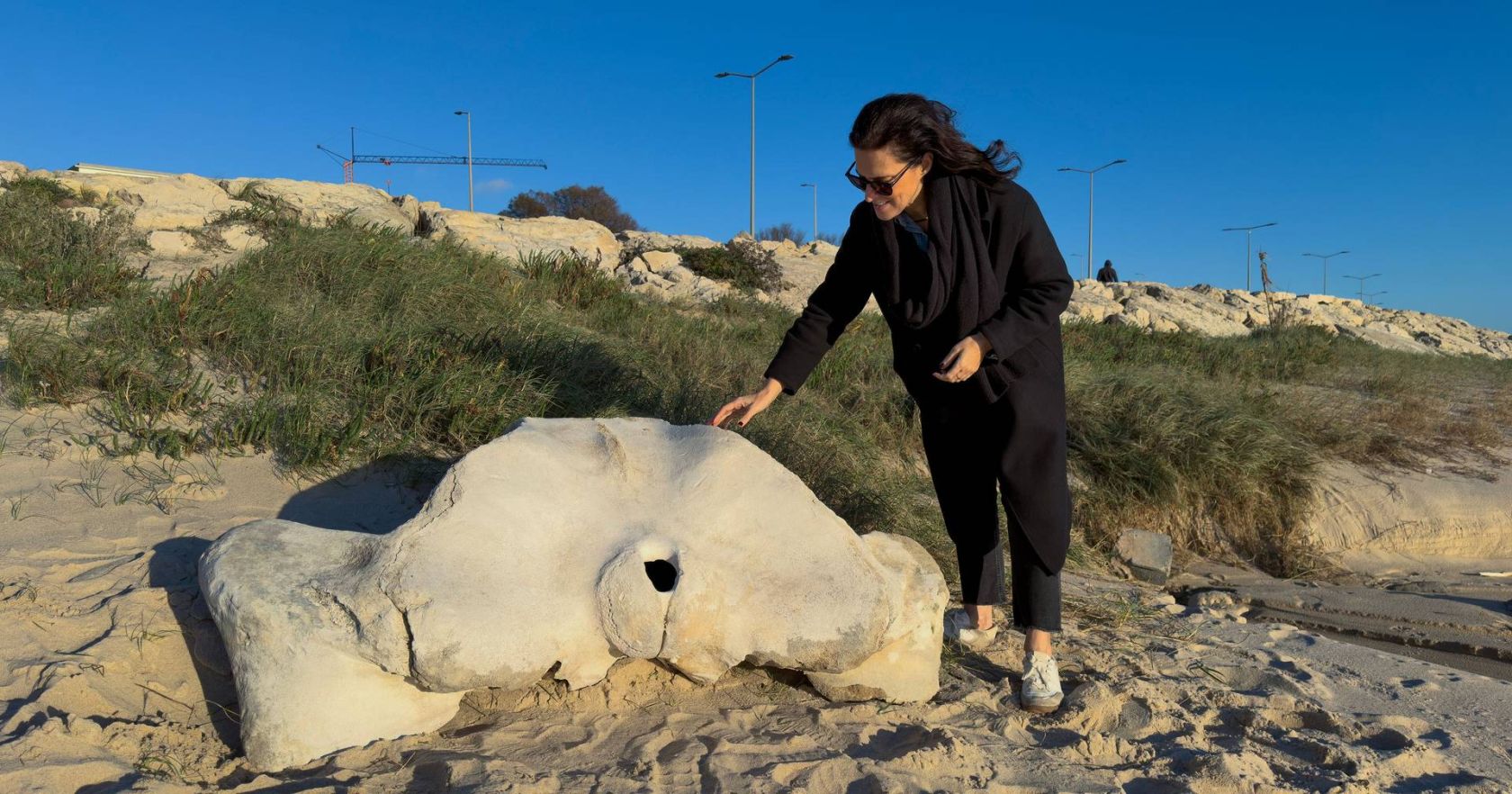
The operation, carried out by five firefighters from the Figueira da Foz Fire Brigade (CBS), was intended to preserve the find, bones measuring approximately 1.5 meters long by one meter wide and weighing hundreds of kilograms.
“I cannot specify how much it weighed, but it was very heavy. It was removed from the beach and taken to the museum,” Nuno Pinto, commander of the Fire Brigade, told Lusa news agency.
Although initially described as a perfectly symmetrical pelvic bone that had been on the sand of Pedra Grande for several days, later information indicates that it is, in fact, the back part of a whale's skull, surrounding the brain.
The bone was discovered on the beach by Sílvia Curado, a Portuguese scientist based in the USA, who was walking there with her family.
Following the scientist's discovery, Lusa contacted Pedro Callapez, a palaeontologist from the Department of Earth Sciences at the University of Coimbra, who, based on images of the discovery, particularly of the bone structure in question, anticipated that it was a bone thousands of years old.
“What I can say is that, judging from the photographs, the state of degradation of the skeleton itself suggests that of an individual who is no longer modern. It is relatively common to find ancient sands on the Figueira coast, north of Cabo Mondego, which are sands from the time of the last glaciation. These sands are thousands of years old, sometimes tens of thousands of years old,” explained the researcher.
“And it is very possible that it may have been the skeleton of a whale – possibly a sperm whale, which would have to be confirmed – that was buried thousands of years ago. And it is quite possible that, during storms, there was an exhumation of these bones that came to the coast,” observed Pedro Callapez.
On the other hand, the expert dismissed the hypothesis that it was a dinosaur fossil: “It’s quite different from that. But these are still bones with an ancient appearance. I would almost venture to say that they look like Pleistocene bones that, in the meantime, washed ashore,” he added.
The Lusa news agency tried to contact the mayor of Figueira da Foz, Pedro Santana Lopes, and officials from the Dr. Santos Rocha Municipal Museum, but the attempts were unsuccessful.






 English
 Nederlands
 Deutsch
 Français
 Español
 Italiano
 Svenska
 Pусский
 中文
中文 Türkçe
 Português
 Polski
 عربي
عربي Suomi
Suomi עִברִית
 Português (Brasil)