

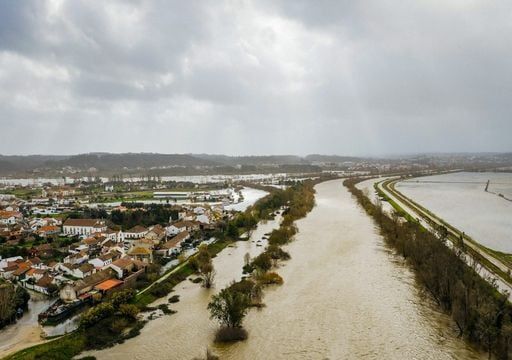
"A project like this cannot be abandoned. The greatest risk is not knowing the risk," the former head of the Order of Engineers told Lusa, warning about the size and type of structure, composed of embankment dikes along approximately 30 kilometres between Coimbra and Figueira da Foz.
Carlos Matias Ramos, who chaired the National Laboratory of Civil Engineering (LNEC), explained that a dike like the Mondego, which collapsed on 11 February, is built under "very strict" rules, taking into account, in particular, the soil type on which it is built.
“I need to know if the soil has the capacity to receive the weight that the dike will receive. Once the work is completed, it has to be strongly preserved,” he said.
“Constant observation of what is happening is necessary,” he reiterated, explaining that based on the results, the designer reformulates the work or establishes a conservation plan.
This is a lateral containment dike project, which must have a margin of 40 to 60 centimetres between the maximum water level (in a flood situation) and the crest (top).
“This level can be eroded if the dike settles,” specified Carlos Matias Ramos, recalling that during the first 10 years after construction, there were no problems with the work.
“It was important that there be a local institution for the entire Mondego basin, to manage the entire system,” he argued, exemplifying that historical data and monitoring around the dikes and the evolution of the entire reservoir should be analysed.
For Carlos Matias Ramos, “everything leads us to believe” that climate change has implications for the equation that needs to be analysed regarding the dike's foundations.
In this sense, he pointed to the monitoring of melting snow areas in the Serra da Estrela mountain range that feed the Mondego River, as well as the higher temperatures currently being observed.
Acknowledging that Portugal is experiencing an exceptional situation in which the rain “does not let up,” the former president advocated for adjustments appropriate to the project's cycle and for attention to the effects of climate change, which are increasing the risk.






 English
 Nederlands
 Deutsch
 Français
 Español
 Italiano
 Svenska
 Pусский
 中文
中文 Türkçe
 Português
 Polski
 عربي
عربي Suomi
Suomi עִברִית
 Português (Brasil)