

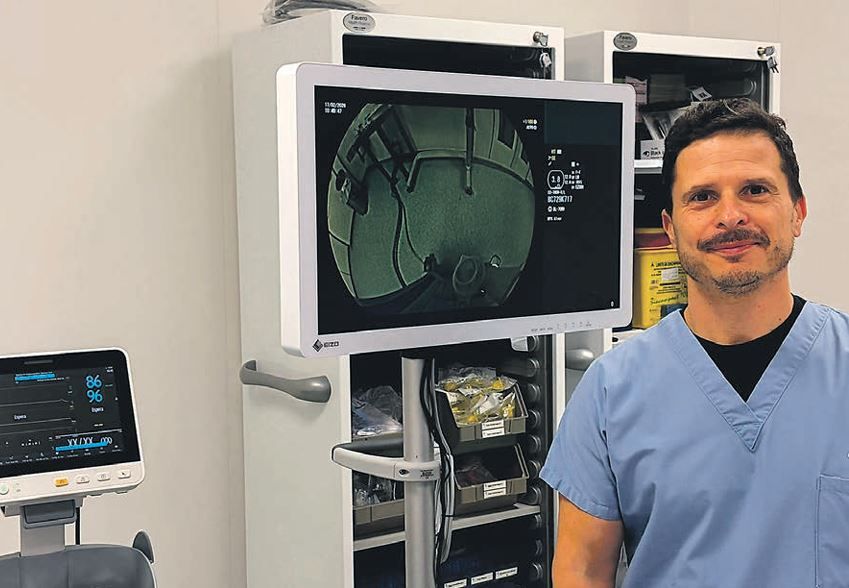
At the heart of this technical revolution is Dr. André Sancho Ramos, a gastroenterologist who has dedicated his career to advancing therapeutic endoscopy.
With a solid career spanning more than a decade and a half, the specialist has become a reference in the region, bringing to the Algarve's private sector expertise that, until recently, required patients to travel to the major urban centres of Lisbon or the North of the country.
Dr. André Sancho Ramos' career is marked by technical rigour that began to take shape long before his arrival at the HPA Group. Having completed his specialisation in 2010, the doctor has already accumulated 16 years of practice dedicated almost exclusively to the most complex aspect of gastroenterology: advanced endoscopy. This dedication is reflected in his time in the public sector, namely at the Algarve University Hospital Centre (CHUA) in Faro, where he was one of the main drivers behind the implementation of submucosal dissection techniques. His transition to HPA was, as he himself describes it, "a marriage of interests," uniting the institution's desire to invest in cutting-edge technology with his vast experience in highly complex interventions.
Currently, Dr. André Sancho Ramos leads procedures that treat benign pathologies, such as oesophageal diverticula and achalasia, as well as early-stage oncological tumours. Through the Endoscopic Submucosal Dissection (ESD) technique, the doctor is able to perform what he calls "scarless surgery," guaranteeing record-breaking recovery without the physical marks or pain associated with traditional methods.
Interview with Dr. André Sancho Ramos
The Portugal News (TPN): What makes this technique for treating oesophageal diverticula so innovative in this branch of medicine?
André Ramos (AR): This technique goes far beyond simply treating a diverticulum; it represents a paradigm shift. It is based on the principle of "third-space endoscopy." To contextualise, when we introduce an endoscope, we work in the lumen of the organ—the first space. Laparoscopic surgery works in the peritoneal cavity—the second space. We create a virtual "third space" between the mucosa and the muscular layer. There is even a fourth space, where we navigate between the muscular layers themselves. In the case of diverticula or achalasia, the goal is to cut the hypertrophied muscle that prevents the passage of food. Through this tunnel, we access the muscle, perform the myotomy (cut), and finally, close the entry point with special clips. It is a highly precise surgical intervention performed entirely endoscopically, without any external incision.
TPN: How has this technique been applied in the Algarve region, and what is your personal experience with it?
AR: I have been dedicated to the complex therapeutic aspect for about 16 years. My move to the HPA Group reflected precisely this ambition to advance in oncology and complex benign diseases. We were pioneers in the Algarve in performing these interventions in the private sector. We use microscopic "dissection knives" that allow us to "scalp" the lesions. It is meticulous work, as the walls of the oesophagus and intestine are very thin. We have to deepen the recession margin to ensure the lesion is completely removed, while maintaining the integrity of the organ to avoid perforations. This experience, which began at the public hospital in Faro and is now consolidated at HPA, allows us to offer a safe alternative to classic surgery.
TPN: To what extent does this innovation benefit cancer patients in the early stages, and how does recovery work?
AR: The benefit is immense. In the past, many of these tumour polyps were removed in a fragmented way, resulting in a recurrence rate of around 20%. With dissection, we remove the "tree with the root” (the principle of uprooting), ensuring free margins. If the tumour is at an early stage and there are no signs of lymph node spread, the cure is total and definitive with this procedure alone. As for recovery, it is super fast. The patient is hospitalised for only one night as a precaution. The next day, they are discharged, return home practically pain-free, and in a few days resume their normal diet, progressing from liquids to solids. It is the end of the heavy post-operative periods of 5 or 7 days of hospitalisation.
TPN: What are the plans for the future regarding the dissemination of this technique in the region?
AR: The main plan is awareness. We need to be present and make ourselves known, not only to the public but also to our peers.
Often, a family doctor or surgeon, out of habit, refers the patient to traditional surgery. My job is to show that the endoscopic alternative exists, is effective, and is available here in the Algarve. We want this to be the first option and not the last resort. The Algarve has a very diverse population, with many foreign residents who bring pathologies with varying incidences, and we have the capacity to respond to everyone, ensuring that no one needs to leave the region to access the best medical technology available.
The Future of Minimally Invasive Medicine
The implementation of these advanced techniques by Dr. André Santos Ramos and the HPA Saúde Group marks a turning point in Algarve medicine. By transforming interventions that once required large incisions and prolonged recoveries into highly precise outpatient procedures, the region's health sector reaffirms its competitiveness. The focus now lies on clinical education and health literacy, ensuring that the diagnosis of an early tumour or oesophageal motor disorder is no longer synonymous with surgical trauma, but is seen as a problem that can be resolved safely, subtly and, above all, clinically effectively.
Appointments and exams can be scheduled via the website at www.grupohpa.com, via the myHPA Saúde app, now also available in English, or by calling (+351) 282 420 400.






 English
 Nederlands
 Deutsch
 Français
 Español
 Italiano
 Svenska
 Pусский
 中文
中文 Türkçe
 Português
 Polski
 عربي
عربي Suomi
Suomi עִברִית
 Português (Brasil)