


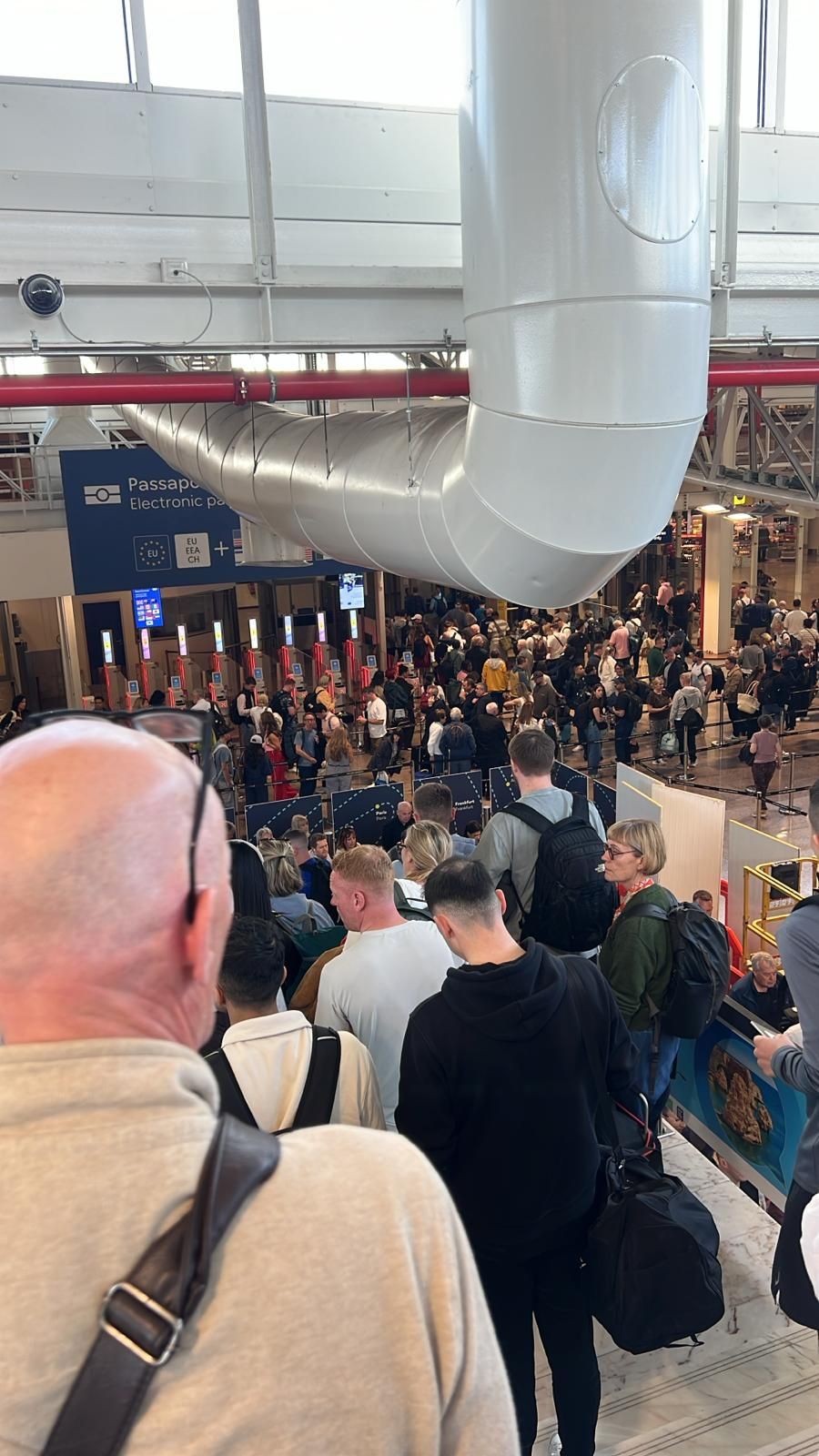
According to a traveller at the airport, from the moment they reached the queue from the top of the stairs for entry to clearing passport control, the process took approximately 40 minutes, reflecting a notable improvement compared to the typical peak-hour delays of up to three hours or more.
The reduced waiting times were largely attributed to the temporary unavailability of the Entry/Exit System (EES), which is currently being implemented across European borders.
In the absence of the automated EES procedures, border control officers reverted to traditional passport stamping. Although manual processing might seem slower in theory, in this case, it streamlined the flow of passengers. By avoiding extra biometric checks and system registrations, travellers were able to move through queues more efficiently.
Furthermore, the airport staff appeared to be well prepared to handle the adjustment, maintaining steady lines and ensuring that passengers were processed without complications.
This situation highlighted the transitional phases of new technology rollouts, as temporary changes can sometimes yield unexpected benefits, with Faro Airport demonstrating that operational flexibility can help sustain smooth performance, even when systems are offline.
While the EES is expected to enhance border security and modernise travel in the long term, today’s shorter queues offered a welcome reminder that sometimes, simpler processes can still deliver a faster journey.








 English
 Nederlands
 Deutsch
 Français
 Español
 Italiano
 Svenska
 Pусский
 中文
中文 Türkçe
 Português
 Polski
 عربي
عربي Suomi
Suomi עִברִית
 Português (Brasil)
When will tax paying residents be treated better, and not have to queue for the same time as tourists. We already submitted biometrics and finger prints.
By Michael from Algarve on 16 Apr 2026, 17:58
Some of our guests were nearly two hours this morning so maybe they could shut the system off more often!!
By Dougal Gow from Algarve on 16 Apr 2026, 20:28
Nobody seems to be advising on the process for passengers who have already had their biometrics taken ? Why should people be delayed at arrival if their biometrics have successfully been captured , people are stuck in queues with passengers waiting to be captured for the first time which is very frustrating , surely a streaming process can be introduced asap ?
By John from Algarve on 16 Apr 2026, 21:15
Delays of over two and a half hours experienced at 1130 today. Horrific queues following only six flights from the UK in he previous hour.
This situation is not acceptable.
Who's to blame....Boris Johnson or unfriendly EU officials?
By Graham from Algarve on 16 Apr 2026, 21:16
Michael. Yesterday when I said to the woman in Faro directing the line through emigration that I am a resident, she said ‘é a mesma coisa que a UE’ and sent me down the EU line. No problem as I reached the agent checking passsports. So I’m going to stick to that in future. We shall see what happens when I return next week.
By Alison from Algarve on 17 Apr 2026, 09:52
As I understand it, EES was finally due to be implemented last Saturday - but a day or two later it was suspended to reduce waiting times. Presumably it was briefly re-introduced before the system went down again a day or two ago?
What your photo clearly shows - though when it was taken isn't clear, although it could have been on almost any day - is that the e-gates are all showing red lights and are out of action. These are for e-passports and not specifically lioked to EES, but they seem to be out of action more often than not. If they want to improve the flow of passengers, why not just switch the e-gates on as well?
By David Collins from UK on 17 Apr 2026, 11:30
Who thinks 40 minutes queuing for immigration is a good outcome? This is utterly shocking and it is a function of the lazy and incompetent immigration system. Who on earth would want to come for a holiday in the Algarve and be greeted by this welcome. They should look elsewhere. Wake-up arrogant Portugal. Stop blaming the EU and get your systems and personnel working effectively.
By Rick Medlock from Algarve on 17 Apr 2026, 22:49
When the media trumpets that there was "only a 40 minute wait" for an entry at an airport, it is a crying shame. I cannot blame the Immigration staff at all, (who have always shown constraint and professionalism in the face of massive pressure, in my experience), but a flawed process, inadequate systems, and poor management.
When you then layer in the new EES system, which in the long run may well resolve the delays but now requires registration time, you have an unacceptable situation. I have several friends who are regular visitors but will not visit Portugal this year because of the hours spent in airport queues and have chosen to holiday elsewhere until "this mess is sorted out".
By Anthony Williams from Other on 18 Apr 2026, 07:23
Alison, I always show my Residency card to the first official that I encounter. About 1 in 5 say use EU line the others say "UK passport".
Returning to Portugal after Easter I went to the E gates, while my Wife decided it would be quicker just joining the All passports queue. She took > 30 minutes, I was < 3 minutes. Biometric passport scan, gate open then pleasant lady in a cubicle quickly scanned my ID card.
It depends on the officer that you first encounter, and if E gates are open.
By Michael from Algarve on 18 Apr 2026, 08:49