

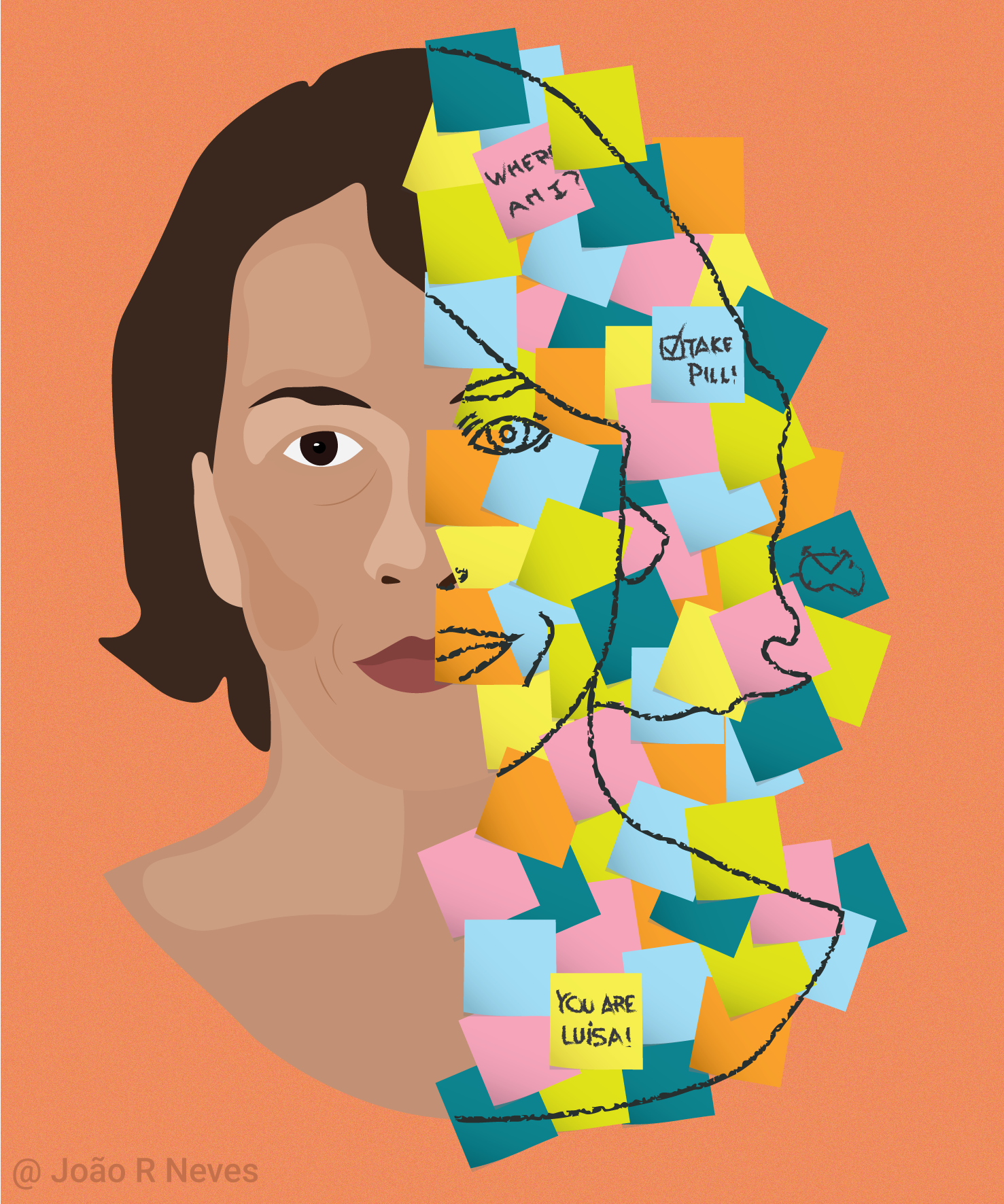
Not as something to fear, nor as a problem necessarily to be solved by technology, but as something biology can help us understand, and in a way navigate better. It is a perspective shaped as much by science as by temperament.
Spending enough time speaking with Luísa allowed me to see the way she leans toward curiosity, even as methodology, an underground kind that tolerates slowness, complexity and uncertainty. The kind willing to stay with a difficult question for years. In many ways, that has shaped her career.
Curiosity from the public-school classroom
Luísa insists, almost pragmatically, that she is a product of public school, because for her it carries political weight. Science, she argues, is too often imagined as belonging to privileged trajectories, when talent is much more widely distributed than opportunity.
Growing up in Portugal’s Oeste region, in Bombarral, public education gave her not only academic training but something she still values deeply: diversity, resilience and an early understanding that progress often depends on self-direction.
There is one episode she cannot forget. At seventeen, convinced she needed stronger preparation to enter university, she moved alone to Lisbon for her final year of high school. It was, she says, one of the hardest periods of her life. At times, she was treated as someone arriving from the periphery; a teacher told her not to expect the same grades she had achieved “where she came from”. Luísa responded by doing better.
Beneath this familiar narrative of overcoming adversity lies something recognisable in the scientist she later became: a refusal to accept assumptions and an eagerness to test everything first.
Science itself was not initially a certainty. At the beginning of high school, she was divided between humanities and science, drawn equally to literature and scientific thinking. She chose pragmatically, reasoning she could read history on her own more easily than learn mathematics or physics alone. Yet this path had been seeded much earlier, when, as a child, she received a book about Marie Curie. It showed her that, as a woman, it was possible to stand at the forefront of knowledge. In that book, young Luísa wrote a premonition: “I want to be a biologist.”
A deliberate detour
Luísa’s scientific career was not linear. After her doctorate, she left academia for industry, joining Nestlé research in Switzerland and working on what would later become a major frontier: gut-brain interactions.
It was an unusual move for someone who would later lead an academic laboratory, but entirely deliberate. The experience exposed her to a different scale of scientific resources, different rhythms of research and different cultures of collaboration. She could have stayed, given the advantages of private research, but returned to Portugal. Not because conditions were easier, they were not, but because she believed scientific life could be built here.
Perhaps because of this trajectory, she remains unusually open about the legitimacy of multiple scientific careers, academic, industrial or interdisciplinary. She resists the old hierarchy that treats only one route as serious. Science, in her view, grows through permeability.
Studying what allows function to endure
Much of Luísa’s work has centred on memory, ageing and cognition, but increasingly her focus has sharpened around a question she sees as neglected: not only why the brain fails, but how it remains functional.
In a field focused largely on neurodegeneration, her work has increasingly insisted on understanding healthy ageing itself. What allows some brains to preserve remarkable cognitive function into advanced age? Why do trajectories diverge even in the absence of overt disease?
These are deceptively difficult questions. Mimicking ageing in animal models takes time and fits poorly into short funding cycles. Yet she seems drawn precisely to problems that resist haste. In her science, there is a clear preference for depth over speed. She recalls a phrase from João Lobo Antunes: “don’t cut corners.”
Her group has contributed to areas ranging from circadian rhythms and cognition to synaptic calcium changes during ageing, work that has sometimes challenged longstanding assumptions in the field. Speaking about these discoveries, it was striking to see that Luísa still retains an almost childlike thrill when stepping into something newly understood.
Against decline as inevitability
In an era fascinated by anti-ageing technologies and regenerative promises, Luísa often returns to a simpler and perhaps more important idea: preserving autonomy. In countries like Portugal, where demographic ageing is both a scientific and social urgency, she resists alarmism. Most ageing, she reminds us, is healthy, meaning without degenerative disease. Yet we need to understand resilience in order to provide healthy longevity and cognitive independence to a greater portion of the population. That changes the question; instead of asking only how to cure neurodegeneration, one asks how to preserve the conditions that make degeneration less likely.
Her interest now is not simply how to treat cognitive decline, but why some people reach advanced age with striking preservation of function while others do not. It is a question of vulnerability, but also of resistance.
Science beyond the laboratory
To know Luísa only through her research would be to miss completely what she is as a professional. She has become one of the more visible scientific voices in Portugal, through public communication, media interventions, and, more recently, writing, including a book exploring the neurobiology of love. She makes an important distinction: communication is not science itself. Science advances in laboratories, through experiments, critique and evidence. But society may gain when science becomes speakable.
Not every scientist must become a communicator, she insists. But scientific knowledge carries a responsibility to reach beyond specialist circles, particularly when publicly funded and socially relevant.
There is also something personal in it, since language and conversation are part of who Luísa is. One senses communication is not a strategic extension of a career, but part of how she thinks, and perhaps how she listens. Public engagement also feeds science back to itself, through the questions people ask and the reminders of what matters outside the laboratory.
A science of preservation
Asked whether her research reflects something of herself, she answers without hesitation, “of course”. Her attraction to long, difficult questions, her willingness to work slowly, even her preference for studying preservation rather than collapse, all of it carries something of temperament.
What stands out about Luísa Lopes is not only that she studies memory and ageing, but that she approaches both with a refusal to reduce them to decline. She is interested in what endures, in neurons, in cognition, and even in institutions and people. Perhaps that is the deeper thread running through her science: not merely understanding what is lost but understanding what allows fragile things to persist.
In the end, we are understanding more about physiological ageing, in part because Luísa once faced discrimination, took charge of her path, and chose to stay with difficult questions long enough for them to yield answers.








 English
 Nederlands
 Deutsch
 Français
 Español
 Italiano
 Svenska
 Pусский
 中文
中文 Türkçe
 Português
 Polski
 عربي
عربي Suomi
Suomi עִברִית
 Português (Brasil)