

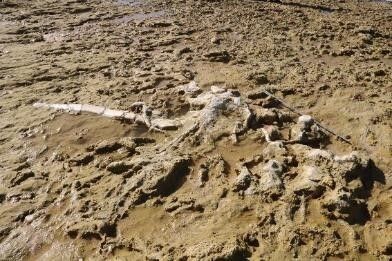
A team of palaeontologists has concluded that fossils found on Galé beach, in the municipality of Grândola, are partial skeletons of two 10-million-year-old whales, among the most complete in Portugal and Europe.
In a statement, the Grândola Municipal Council, in the district of Setúbal, explained that the discovery of these fossils, north of Galé beach, in mid-February, due to bad weather, required a ‘complex operation’ to excavate and remove the remains.
According to the municipality, the work carried out by a team of palaeontologists from the Lourinhã Museum, the Dom Luiz Institute (Faculty of Sciences of the University of Lisbon) and the National Museum of Natural History and Science confirmed the presence of ‘two partial skeletons of fossil whales’.
After the excavation work, the researchers concluded that one of the whale skeletons consists of a skull, two almost complete jawbones and some vertebrae and ribs. The ‘second specimen’ of these whales from the ‘Mysticeti group, which includes today's baleen whales’, preserves ‘an almost complete skull, part of the jaws, several vertebrae and ribs, and possible bones from the forelimbs and shoulder girdle’, he added.
According to the team of palaeontologists, these fossils may belong to ‘a group of small to medium-sized whales, relatively abundant on the Portuguese coast around 10 million years ago’.
‘Currently, this group includes species such as the grey whale and the blue whale, the largest animal on the planet,’ he said.
The two skeletons of these primitive whales are ‘among the most complete Miocene fossils in Portugal and Europe,’ the experts said, pointing out that their study could help to understand their evolution, ecology and way of life.
‘The Miocene in Portugal is particularly rich in fossilised whale remains, with numerous finds in the Lisbon and Setúbal regions, especially in the Lower Tagus Basin,’ the statement said.
Also in the context of what palaeontologists call the Alvalade Basin, which outcrops in the municipality of Grândola, an ‘impressive diversity of marine fossils’ was discovered, including remains of whales, dolphins, turtles, sharks, bony fish and possible birds.
A ‘diverse fauna of invertebrates, including bivalves’ was also identified, the researchers said, adding that this deposit, which extends over 100 metres, is one of the ‘most important fossil associations’ in the Alvalade Basin.
This discovery, which involved an archaeologist and technicians from the municipality and several national and international palaeontologists, could ‘provide fundamental data on the marine vertebrate fauna that inhabited this region during the Miocene,’ they stressed.
The fossils are now in the custody of the Municipality of Grândola and are expected to be transported in the coming weeks to the laboratory of the Lourinhã Museum, in the district of Lisbon, where they will be prepared, conserved and studied.
To reaffirm ‘the joint commitment to the preservation and enhancement of natural heritage,’ the Municipality of Grândola, the Lourinhã Museum and the Faculty of Sciences of the University of Lisbon, through the Dom Luiz Institute, are preparing a cooperation protocol ‘with a view to researching, disseminating and sharing this important palaeontological find with the local community and society’.






 English
 Nederlands
 Deutsch
 Français
 Español
 Italiano
 Svenska
 Pусский
 中文
中文 Türkçe
 Português
 Polski
 عربي
عربي Suomi
Suomi עִברִית
 Português (Brasil)